

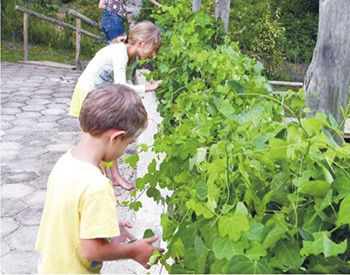
 Farming with butterflies is very rewarding. The first small holding on the South Coast in Margate has proved to be very successful. Children and teachers assist in the picking of butterfly eggs from this hedge alongside the parking area where two butterfly species breed on the vine-like creeper. In this particular hedge, a second creeper also grows which is similar to that of the first which three other butterfly species breed on. The length of this particular hedge is 11m long and only a meter in height. It gets harvested every morning and has produced an astonishing 8900 eggs in one week. This season has been a good one.
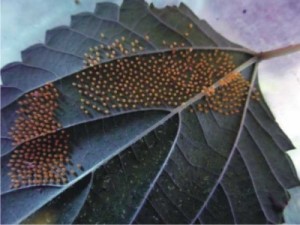 On the right is a photograph of a cluster of eggs from one particular gravid female. You can count the eggs if you want to, but a rough estimation is 420 eggs. The gravid female had not completed laying her eggs, as she was disturbed and flew off. There are usually up to seven females laying eggs periodically from time to time during the day. Some only lay as many as 30 eggs in a cluster where others lay hundreds in one sitting. The larger butterfly species such as the swallowtails lay their eggs singularly and a distance apart, making harvesting more challenging.
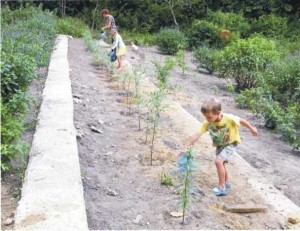 In the photograph on the right (on the left hand side of the cement pathway) one can see the edge of a line of trees that are approximately one meter high on which a certain butterfly species breeds on. This line of young trees is 17m long having 18 young trees in its length. It has been so fruitful in harvesting from it that four other rows of host plants are being planted for yet other species to be bred. On the right hand of the cement pathway, you can see children watering the young new trees which have already started producing fresh eggs laid by one particular species.
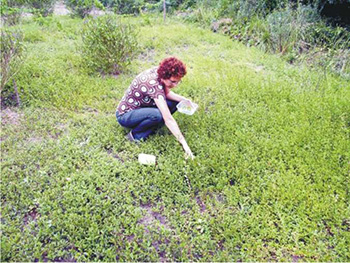 One section has been planted with a ground cover, a short shrub-like plant on which several of the pansy butterfly species breed. Here one of the breeders are harvesting young 2nd instar larva which is taken to a nursery under a more controlled environment, so that the breeders don’t have to spend hours looking for them. This area is 17m long and 6m wide and produces a high volume of larva in each brood of each season. However, in the winter months, the two broods are yielding only 40% of the average yield in the other six broods, being about 6000 harvested larva per brood.
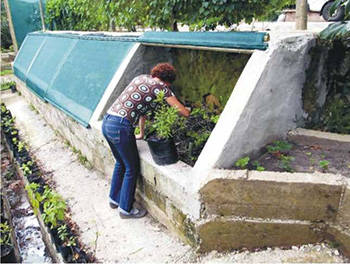 At these controlled breeding boxes, fresh host plants are planted and made ready for the next brood of butterfly larva to be harvested from the farming area. Here all parasites are removed, all other plants removed that have no benefit to the butterflies being bred. These breeding boxes, being a confined space, allow us to be able to regulate the breeding processes more accurately and also allows us the opportunity to record information as the cycles progress with written data and photographs. Many of these recordings have not yet been released to the scientific community and many have been adopted as our trade secrets.
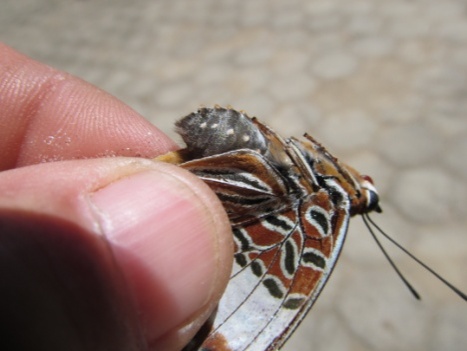 Many of your butterfly species (the gravid females) lay single eggs, opposed to clusters of eggs. These females are bagged into nets that are suspended around a branch of the host plant and left alone, to begin the process of laying their eggs singularly. Because they are prohibited to fly off to some other tree to lay yet again one or two eggs, they walk around the inside of the net and lay one egg here and one egg there. By the time they have completed their laying cycle, we have between 80 to a 120 eggs from one gravid female. Now it is easy to remove the eggs from this branch of leaflets and breed them through. We let the female free.
info@sabba.co.za