
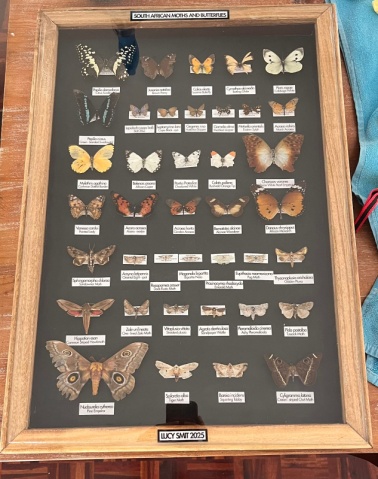
 The hobby of collecting butterflies had its boom in-between the years of 1975 to 1985, when South Africa had over two thousand butterfly collectors. This number had reduced considerably to just over one hundred and fifty by the late 1990’s. But it’s on the rise again. Today there are some serious collectors who still take pride in their collections and have become more scientifically minded. The reduction in general collectors comes with the development of technology.
New digital cameras and other digital equipment has led many interested lepidopteron to adopt the more favoured perfect digital photography and other suitable media to portray what butterfly species look like in the wild.
Many new books have been released over the last few years of natural settings in the wild with butterflies and just about any insect families, including moths, grasshoppers and even frogs, spiders and the like. Hence today there are only a handful of general collectors (people who collect specimens, set them and keep them in cabinets). Some scientific institutions may still collect butterflies for scientific study, such as most of big city museums and universities.
Going back into history, we find that the so-called craze to collect butterflies comes about every thirty or so years in South Africa. World Wide, we find that there is a huge industry for the collecting of various butterfly species with the tendency to rather purchase pupae, let them hatch, mount them for the intended collection, or to buy dead but perfect specimens, relax them with a relaxing agent and remount them for a collection.
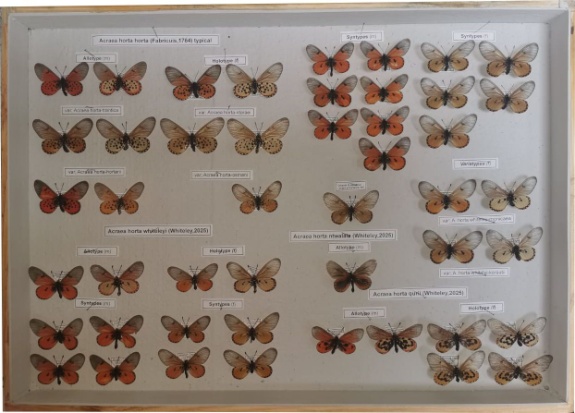 CBISA has a large collection of mounted butterflies as a data bank and proof of the existence of the species it holds. Only two female and two males are in the collection of whatever species there is and a single specimen of variations belonging to any species of only South African Butterflies. There is no necessity to collect hundreds of specimens of each species being males or females, as this would be considered as hording, especially when it comes to rare endangered species. A practice that should be adopted by collectors is to collect only what is necessary for a private collection.